July 18, 2010

Car Market In India

Let us look at some statistics for cars in India and US


In the simplest of terms, the car ownership ratio between US and India is about 80:1
[This is also a measure of difference in lifestyles and the average resources consumed per human being :)]

Total cars sold in India (FY 2010): ~1.6 million
(Maruti sold highest ever number of cars(0.87 million) in India in FY 2010 while maintaining a 54% market share)

Total cars sold in China (2009): ~13.5 million
(China sees 45% growth in car industry year-on-year)

Total cars sold in US (2009): ~10.4 million
(Lowest level in 27 years; Down from 14.5 million cars in 2008)

In terms of the total number of cars, US car market has been more or less stable/saturated for the last few years.
In comparison, Japan had reached car saturation in 1990 itself !!!

Besides, did you know:
  • There are more cars scrapped in US (~15 million) every year than the whole car population of India
  • And there were more cars sold in China (~13.5 million) last year than the whole car population of India

Just like personal computers and mobiles, the world now has over 1 billion cars and is expected to hit the 2 billion mark for cars in a decade or two from now.

Does it mean that the car market in India like China, will follow US in car sales and car population and eventually have 20 times more annual car sales and 80 times increase in car population in a decade or two?

I believe NOT (In fact, I hope NOT)

Why NOT ?

Well, do we really need those many cars?
  • One, in India it makes more sense to measure "cars per family" rather than "cars per person".
  • Two, nearly 65% of India's population (~760 million people) lives in villages and small towns which are barely walking distance from start to end.

Besides, there are plethora of more reasons…

INFRASTRUCTURE
The biggest and the most immediate barrier is certainly the lack of Infrastructure. We are so stuffed that all of us cannot really move fast at the same time :)

With the state of the road infrastructure in India today and the ever increasing car density, in most cities, it has already become meaningless to commute to workplaces by cars.

SCALE
Can maruti or other companies scale out their manufacturing capacities by 10 or 50 times that fast. May be not. But in all likelihood, we will see an annual growth rate of at least 20% to 30% in the Indian car market for next decade or two.

FUEL
Perhaps, we would run out of fuel before everyone has a car. Fuel prices are on a constant rise. The Indian government bears the brunt of over Rs: 50000 crores (USD 10 billion) annually on fuel subsidy.

Can the government even think of affording 80 times this amount annually if the car population and fuel requirement go up 80 times to match the "cars ownership rate" of the US :) (Perhaps more, as this would most definitely lead to significant rise in fuel prices led by the humongous increase in demand)

(USD 800 billion or more: that's more than what it took to bail out the US economy from the 2008 housing debacle :))

AFFORDABILITY and LIFESTYLE
More than half the population still survives on less than $1 a day (can they think of affording a car, even if it is "Tata Nano" priced at just $2500) Moreover, we have more important problems to address first.

In fact, to be brutally honest: On an average, every Indian does not even have 50 sq feet of room/living space, which is what it takes to park a small car (Leave aside other basic needs)

On a lighter note, India actually has 10 times the number of motor cycles than the US :)
So you see, we have different "dynamics"!

And more than ever before, we need population control.
(India occupies 2.4% of the world's land area and supports over 17.5% of the world's population)
"ek minute artaalis bacche, kaise bitaayenge acche"

We need means of mass transportation for local commuting … such as metro, efficient bus/shuttle services and car pool efforts
(I know, I know, nearly 20 million people travel by Indian Railways every day… but that's not all local commuting; moreover, that's still not enough)

We need to improve/expand our infrastructure (Bridges, Railroads, Highways and Roads…)
We need alternate means of fuel.
We need government policies/subsidies to promote/encourage/accelerate all of the above.

[Did you know that the government in many places offers to purchase power from Solar based power plants @ Rs: 15/- to Rs: 17/- in comparison to under Rs: 6/- from coal/fuel/hydro based power plants. Now that's such a neat example!]
 
Wow… there are so many Opportunities all around us!

In fact, I am overly sure of seeing development/focus on all of the above needs over the next several years.

Err... in the midst of all this, I believe we completely forgot to think about "Global Warming" !!!

June 24, 2010

Efficient Market Theory

Warren Buffet’s thoughts on Efficient Market Theory
From his 2006 letter to Berkshire Hathway Shareholders


In 2006, promises and fees hit new highs. A flood of money went from institutional investors to the 2-and-20 crowd. For those innocent of this arrangement, let me explain: It’s a lopsided system whereby 2% of your principal is paid each year to the manager even if he accomplishes nothing – or, for that matter, loses you a bundle – and, additionally, 20% of your profit is paid to him if he succeeds, even if his success is due simply to a rising tide. For example, a manager who achieves a gross return of 10% in a year will keep 3.6 percentage points – two points off the top plus 20% of the residual 8 points – leaving only 6.4 percentage points for his investors. On a $3 billion fund, this 6.4% net “performance” will deliver the manager a cool $108 million. He will receive this bonanza even though an index fund might have returned 15% to investors in the same period and charged them only a token fee.

The inexorable math of this grotesque arrangement is certain to make the Gotrocks family poorer over time than it would have been had it never heard of these “hyper-helpers” Even so, the 2-and-20 action spreads.

Its effects bring to mind the old adage:
When someone with experience proposes a deal to someone with money, too often the fellow with money ends up with the experience, and the fellow with experience ends up with the money.

Let me end this section by telling you about one of the good guys of Wall Street, my long-time friend Walter Schloss, who last year turned 90. From 1956 to 2002, Walter managed a remarkably successful investment partnership, from which he took not a dime unless his investors made money. My admiration for Walter, it should be noted, is not based on hindsight. A full fifty years ago, Walter was my sole recommendation to a St. Louis family who wanted an honest and able investment manager. Walter did not go to business school, or for that matter, college. His office contained one file cabinet in 1956; the number mushroomed to four by 2002. Walter worked without a secretary, clerk or bookkeeper, his only associate being his son, Edwin, a graduate of the North Carolina School of the Arts.

Walter and Edwin never came within a mile of inside information. Indeed, they used “outside” information only sparingly, generally selecting securities by certain simple statistical methods Walter learned while working for Ben Graham. When Walter and Edwin were asked in 1989 by Outstanding Investors Digest, “How would you summarize your approach?

Edwin replied, “We try to buy stocks cheap” So much for Modern Portfolio Theory, technical analysis, macroeconomic thoughts and complex algorithms.

Following a strategy that involved no real risk – defined as permanent loss of capital – Walter produced results over his 47 partnership years that dramatically surpassed those of the S&P 500. It’s particularly noteworthy that he built this record by investing in about 1,000 securities, mostly of a lackluster type. A few big winners did not account for his success. It’s safe to say that had millions of investment managers made trades by a) drawing stock names from a hat; b) purchasing these stocks in comparable amounts when Walter made a purchase; and then c) selling when Walter sold his pick, the luckiest of them would not have come close to equaling his record. There is simply no possibility that what Walter achieved over 47 years was due to chance.

I first publicly discussed Walter’s remarkable record in 1984. At that time “efficient market theory” (EMT) was the centerpiece of investment instruction at most major business schools. This theory, as then most commonly taught, held that the price of any stock at any moment is not demonstrably mispriced, which means that no investor can be expected to overperform the stock market averages using only publicly-available information (though some will do so by luck). When I talked about Walter 23 years ago, his record forcefully contradicted this dogma.

And what did members of the academic community do when they were exposed to this new and important evidence? Unfortunately, they reacted in all-too-human fashion: Rather than opening their minds, they closed their eyes. To my knowledge no business school teaching EMT made any attempt to study Walter’s performance and what it meant for the school’s cherished theory.

Instead, the faculties of the schools went merrily on their way presenting EMT as having the certainty of scripture. Typically, a finance instructor who had the nerve to question EMT had about as much chance of major promotion as Galileo had of being named Pope.


Tens of thousands of students were therefore sent out into life believing that on every day the price of every stock was “right” (or, more accurately, not demonstrably wrong) and that attempts to evaluate businesses – that is, stocks – were useless. Walter meanwhile went on overperforming, his job made easier by the misguided instructions that had been given to those young minds. After all, if you are in the shipping business, it’s helpful to have all of your potential competitors be taught that the earth is flat.

Maybe it was a good thing for his investors that Walter didn’t go to college.

June 5, 2010

My Favorite Business

So what's your favorite business…
People often ask me this question and my answer is always the same...

The businesses that I like the most are the ones that are most profitable :) 
More specifically...

I like businesses with predictable profits in which profits grow linearly (or exponentially) with the growth in business (i.e.: Same or higher ROI/ROE on incremental/expanded business)... "Economies of Scale"

Whereas, I like to avoid businesses that either fetch lower ROI/ROE on incremental/expanded business... "Diseconomies of Scale" or those that require massive amounts of debt/capital investment to scale out/expand... without a clear visibility of profits...

Three kinds of businesses that I like:

Selling products at high margins
(This is achievable and sustainable through one or more of: high brand value/mindshare, (beyond compare / distinguishing) product quality/service/experience, secret formula/patents and sticky products)
  1. Apple: sells hardware at amazing margins
  2. Coke: sells soft drinks at amazing margins (Further, having globalized well, it can potentially sell "1 billion" bottles a day while maintaining high margins) (imagine!) 
Products with very low variable cost
It may have taken Microsoft $7 billion to develop Windows 7.
A copy of windows retails anywhere between $49 and $399.

However do you know how much does an incremental sale of Windows 7 cost microsoft?
Yes, they burn the software on empty DVD's worth after $1 or $2

The profit margins increase with every additional unit sale.

Most product based software companies come in this category.
Some more example would be production houses(movies), writing books and enjoying royalties etc

Off course, such a business may make loses until it recovers the fixed cost (threshold unit sales), beyond which everything is but neat Profit.

Platforms and Services
(Businesses that don't require huge capital for "scaling out")
e.g.: Security brokerage, Services, Consultancy

Developing platforms for buyers and sellers to meet and trade is a wonderful business. (and so is providing platforms for people to develop and host)

The variations range from all Stock Exchanges, Brokerage houses, Ebay to the modern world Windows Azure, Facebook, .Net/Visual Studio and what not...

Just like the government, you get to collect brokerage/share on all transactions, whether or not the individual makes a profit. "More trades/transactions/volumes --> more brokerage and earnings"

Another good thing about these businesses is disposable earning. The profits need not be reinvested to sustain or grow the business and hence can be distributed as dividends or used in other businesses.

Looking at it, even Telecom, Broadband and DTH services come under the category but these specifically require huge sums of Capitals.

(Do NOT confuse this with physical retail which not only requires capital investments but also requires managing huge inventory)

Additionally, I like a special category of businesses that I like to call "Naturally Growing businesses"

These businesses are like my long term investment portfolio. Profits in these businesses in some sense are directly proportional to the book value (while the differentiation also comes through effective management etc) These grow incrementally/consistently year after year in their book value yielding some dividends and reinvesting the remainder of profits. Any equity dilutions at a price above book value is usually favorable for existing shareholders.

Barring few exceptions, most well managed banking and finance companies would come in this category.

June 4, 2010

Economies of Scale...

May 1995

Every once in a while, in those hot summer afternoons, a marketing fellow from either HLL or P&G would ring the door bell and announce schemes like: "For every women/girl in your house, we will give you a complimentary sachet of our new product. e.g.: Sunsilk shampoo"

I would soon start jotting down feminine names and not stop writing until either my mind ran out of names or the marketing guy ran out of stock :) [With dozens of sachets in my hand, I often felt like the smartest child on this planet :)]

Among other funny conversations, I specifically remember one incident when the marketing guy asked me if the house was actually a girls hostel :)

Wow, this was even better than negotiating and selling old newspapers and scrap to make for a little extra pocket money
(To be frank though, the money either got spent buying gifts for my sister or was saved in my Piggy Bank)
I was very young, just about 11 years old, and I had figured out my way to the riches…

If I could collect Rs. 1/- each (beg, borrow, steal) from every Indian, I would have collected a billion rupees (~USD 22 million) and become a rich man.

Well, as I grew up I realized that there was actually nothing wrong about my plan, just that I could do this in a more intellectual way than actually reaching out to people directly asking for money.


On 15th March 2010, Reliance Communications announced that it has hit the "100 million customer" mark (i.e. 10 crore customers) and targets to have "200 million customers" (i.e. 20 crore customers) in next 1000 days (FY 2013)

Ignoring the current or previous numbers, capital investments, expenses, debt etc for now…

Let us try to understand what it means to have 100 million or 200 million customers (in less than 3 years)...

On the operational side, it means being able to manage as many customers (in terms of network scale out, managing customer records, outlets for recharge/bill payments, billing, logistics, customers support) among other things.

On the business/earnings side, it means having 200 million customers using the services and hence putting money is company's pocket either through monthly bills or recharges.

There are several approaches to maximizing/increasing revenue from customers from collecting fixed monthly charges to various value added services to text advertisements etc

After accounting for all forms of expenses from managing networks and call centers, employee cost, interest cost, depreciation etc, If the company just manages to make a net profit of Rs. 1/- per customer per day (come on, this ain't too much to ask for)

Well, seeing the ever increasing number of junk/bulk messages on my mobile, I for one believe that the company could earn Rs. 1/- a day per customer from text advertisements alone.

200 million customer * Rs. 1/- per day… translates into a net of Rs. 6 billion a month or Rs. 72 billion a year… i.e.: $1.6 billion in annual profits

I am sure the management, strategists, business planners or promoters at the company, even on bad days would target for more profits per user than a mere Rs. 1/- per day

If they can manage to extract Rs. 2/- per day from customers, it would translate into $3.2 billion in annual profits
(aha, I am loving it…)

Big numbers multiplied by numbers as small as 1, still yield big numbers… that's the beauty of a high volume business...
On the other hand, the same big number game can have catastrophic results, when big numbers are multiplied with negative numbers, however small.

Economies of Scale...

April 19, 2010

The "10-baggers"

10-bagger: A stock whose price multiplies 10 times over.

Is it possible to get 9x returns through equity investments in 2-5 years ?

I haven't actually reverse engineered to find all stocks that increased over 900% in a 2 to 5 year period with an attempt to find patterns…though as I write this, it does'nt sounds like a bad idea at all...

Breaking the Myth

What kind of stocks do you think can give 9x returns?

I know, I know... most people do not think of 9x returns in the first place...
Come to think of it and the first thing that is likley to hit the mind is....ah, it's gotta be a micro or small cap stock...well, at least this is what I initially thought...

And after all the study, discussion and experiments with my mentor and partner in Investing, our first successful 10 bagger (actually 9 bagger to be precise) investment was Reliance Industries which was already the 2nd biggest company in the country by market cap at the time we invested…huh!

"Sum of parts is often more than the Total"
In 2005, while the buy back was on amidst the brotherly dispute, there was huge underlying value in Reliance which in my opinion did not get reflected in the valuation. The thing that I really liked about the company was that every once in a while, one of the underlying businesses like telecom, energy, capital, retail etc under Reliance would mature and pop out.

Back then, my uncle used to describe Reliance Industries as:
"a hen that gave a golden egg once every 2-3 years !"
If you got to have a healthy baby, you gotta nurture and feed it well, and so did Reliance use it's free cash flow to conceptualize, start and grow these businesses internally. For the first few years though, babies often need extra nourishment and affect the earnings (not the future earnings potential though). These babies were unseen/unvalued by the world (or the investor community so to say) hence resulting in a lower overall valuation of the consolidated business, than what would have been the valuation of the company standalone itself. These (perceivably unwanted) babies were huge businesses (blue chips) in the making, that were presently consuming cash and lowering the immediate profits.
If only one tried to see these businesses separately and value them 2-3 years forward, would he have seen the true underlying value…

Unfortunately (though for me, a blessing in disguise), most people have to be shown different pieces separately to be able to see the value… put them all in a box and they start valuing the box without knowing the contents.


To show it mathematically
  1. Business A makes a profit of 10 million on sales of 100 million and grows at 20% annually and is valued at 200 million
  2. Business B makes a loss of  (3)  million on sales of  50 million  and grows at 30% annually and is valued at 100 million
(Note: Business B is in it's early/growing/capital demanding years)

Now imagine that these 2 businesses A and B are part of one single company AB and hence the consolidated results of company AB are shown as:
  1. Company AB makes a profit of 7 million on sales of 150 million and grows at 23% annually
Would you value the business at 140 million or less or 300 million?

As I said: "Sum of parts is often more than the Total"

Having said that, smaller companies are indeed more likely to fetch 10x returns for the reasons of the nature (Unless off course there is no limit on the market size and companies such as coke and Wal-Mart can find customers and favorably open retail stores on Venus, Mars and Jupiter)

(Start with Venus, I heard that women are from venus, so there must be a lot of craze for shopping out there too…)

While I usually restrict myself to look out only for consistently growing businesses that are ready for the next big leap...

Sure, you could get 10x returns in cyclic or commodity businesses too...
After all, every dog has a day, and when the demand-supply equation is favorable for a commodity business, it can certainly grow 10 times in a run up…most often eventually followed by a significant fall as the pendulum swings back or to say when the demand-supply equation turns back upside down, since these are cyclic after all...

Note: 10x returns need not always be the result of 10x growth in the business or underlying profits

10x means the market capitalization of a business becoming 10 times (or more than 10x if there is equity dilution and less than 10x if there is buy-back on the way...)
Now to explain this in a bottom-up or "per share" way:

Market Price of a Stock = EPS * P/E  
(where P/E = Market Price / Earnings Per Share)

From my understanding and observation of successful 10 baggers so far, it is the multiplication factor of the enhancement in these two variables, that leads to 10x returns…
  1. EPS (Earnings per share) growing about 2 to 4 times in this period
  2. P/E growing 2 to 4 times in this period

EPS Growth

For a good business growing earnings at around 30% compounded annually, a 69% to 271% growth in about 2-5 years is not a surprise. After all, 100 * (1.3)^2 = 169 and 100 * (1.3)^5 = 371.29 (compound interest at work)

(Also, 100 * (1.3)^10 = 1378.58 !!!, so a business growing at 30% would be about 14 times in 10 years)

 
Price / Earning Growth
 
Among other things, P/E is often a result of market liquidity, investor confidence, growth potential, longevity, confidence in promoters etc…

At macro level, a bull run is very supportive in getting from x to 10x…
With one or more of the following factors: Lower interest rates, higher growth rate for economy, favorable and high ROI for businesses, high liquidity in markets, high investor participation in markets etc
 
It goes without saying, that 10x returns are mostly marked by a huge investor recognition for the business/stock leading the company's move from micro to small, small to medium or medium to large sized business.

The beauty of 10 bagger investing is that even if you have a horrible hit ratio of 10% (one in 10 stocks you pick grows 10 times) you would still be in good profits!
However, with just a 10% hit ratio, the challenge would be in finding 10 potential candidates for the job...

April 17, 2010

Maggi

 
do minute ruk sakte hain, sir ke bal reh sakte hain... 
kyuki, badi gazab ki bhook lagi, maggi chahiye mujhe abhi… Umm, Maggi Noodles ! Maggi Maggi Maggi


People talk about businesses, brands, products, margins, market share what not… I am yet to meet a person between half and twice my age who isn't mad about maggi…

Whether from adventure trips or from school, hostel, college, bachelor days… while some lucky souls get to eat maggi even after marriage…
Talk of maggi and everyone has some fond memories to share…

now that's "mindshare!" … Priceless!

And just like Warren Buffet says, I'd like to say a few things about "Maggi"
  1. If I gave you Rs. 1000 crores or $200 million, would you be able to kill Nestle's "maggi" business… I bet you won't (and I don't have that kind of money to give you anyway)
  2. I know that 5 or 10 years from now, a lot more maggi packets would be selling resulting in more profits :)
Maggi noodles take just about 2 minutes to cook, hence the name
"2 minute noodles !"
How to Prepare: The Maggi noodle cake and seasoning is added into boiling water for two minutes and it is ready for consumption.
 

Most people have their own way of having maggi, while some like it with vegetables, some like it dry, some like it with gravy, some like it with chicken/sausages/eggs, some like it with tomato sauce and some with chocolate sauce, some like it with mushrooms and what not… however, there is one thing common… they all like it one way or the other!

 
Well, making maggi is so simple that when I try to compliment my friend's wife for being a good cook and all (the fact that she cooks maggi really well)… it only upsets her :)
 
A lot of products have come and gone with huge marketing/adv campaigns, but could not beat or put a dent on maggi's share or business…

However, you do get to see some Top Ramen packets from Nissan still around in retail stores (On that note, did you ever ponder why top ramen sells cheaper than maggi)

Forget others, even the numerous variants of maggi supporting the new punch line "Taste bhi Health bhi" (maggi atta, maggi rice mania, dal sambar, tomato, chicken, blah blah blah) combined do not come close to the original Maggi masala 2 minute noodles...

After all, It's in the taste!

Though it is noteworthy that Nestle has actually managed to build several products around the maggi brand, for instance Soups, Sauces, Ketchups, Seasonings, Cuppa mania… etc

Frankly, I haven't seen a maggi advertisement on television for a while now… but I remember going to a retail store exclusively to buy maggi at least several times in last few months… and trust me, if I don't find maggi in a retail store, I am unlikely to visit it again…
now that's the power of a good product or brand!

On a slightly related note, FMCG should benefit a lot from organized retail which is still picking up in countries like India. I don't think a good retail store can survive missing maggi, lays, ketchup, surf excel, coke, pepsi, sundrop oil, britannia biscuits, amul butter etc on their shelves… hence giving these FMCG products easy and expanded visibility/reach… there is certainly a lot more to talk on this subject, however I will leave it for a future blog.

10 bucks is all it takes…and it has been the same for almost 8 years now… Unbelievable... Isn't it ? Even coke has increased its prices from Rs. 5/- to Rs. 8/- (Remember the advertisement campaign: "Thanda matlab…Coca Cola" ... "Paanch matlab Chhota coke"… although chhota abhi bhi chhota hee hai… par ab bade ki price par miltaa hai")

(Well, being a stingy shopper, I know that Nestle reduced the weight of the maggi packets from 100 grams to 95 grams and recently to 90 grams, that's as good as a price increase of 11.11%, without perceivably telling the customer. Nevertheless, it's still worth it!)

There is something about Maggi… Umm ... I can't describe in words, but there is something about her, that makes everyone go mad about her :)

Well, I would consider this blog a waste if you are not craving to have maggi by now… :)

April 15, 2010

Bharti Airtel Top Down

For a business in an unorganized, unexplored or immature sector or market, I like to start with Top Down analysis to evaluate Market Potential (aka the size of Opportunity) and then narrow it down to the specific business leader based on its targetted Market Share, Customer Segmentation etc...
This approach is particularly good for market leaders in upcoming/fast growing sectors… and what better place to start than our population ~1.1 billion or ~6.5 billion if you have plans for globalization :)

Warning: What follows is very crude mathematics.

March 2001
Pagers were badly outclassed by mobile phones. However, these mobile phones were limited to rich and elite. Even incoming calls were Rs. 6/- or Rs. 12/- a minute and incoming text messages weren't free either.

July 2004
The market was ripe with 3 aggressive players: Airtel, Hutch and Reliance. Incoming calls were now free and making outgoing calls or sending text messages was now affordable.

The "turning point" for this market had been reached. The mobile phone cost which was the major "barrier to entry" for the student and the great Indian middle class was addressed both through low cost handsets and also through attractive handset financing schemes by operators.

"The Common Man" was now seen rushing to and queuing at outlets to register for the scheme.

And in what was to follow, you could find even the cab and auto rickshaw drivers, and small retailers / vegetable vendors carrying mobile phones.

Population as on July 2004 --> around 1.05 billion
Mobile Subscriber Base in July 2004 --> around 40 million

Projected Population in 10 years (2014) --> around 1.25 billion
Projected Mobile Subscriber base in 10 years (2014) --> anywhere between 400 million to 800 million

Bharti Airtel's market share (2004) --> around 25%
Bharti's Average Revenue Per User --> INR 563/-

It was more than obvious that average revenue per user was to fall as the mobiles expanded beyond the rich to lower income groups.

Managing same market share would mean over 125 million subscribers for Bharti Airtel in about 10 years… say 2014

At a Monthly ARPU of INR 300/- per user and a user base of 125 million subscribers:

Monthly Revenue potential: around INR 38 billion ($850 million)
Annual Revenue potential: around INR 450 billion ($10 billion)

So we are looking at "a business potentially scaling up to annual revenues of $10 billion in around 10 years"

At post tax margins of 20%, this means ~$2 billion in annual Profits

(Although we are only atrempting to evaluate the revenue potential in the scope of this exercise)

April 14, 2010

Top Down

I love numbers and use them extensively in analyzing businesses..


Big numbers, Small numbers, Growing numbers, Consistently growing numbers, Falling numbers, numbers product numbers, numbers by numbers, old numbers, new numbers, projected numbers, actual numbers… I simply love them all!

However, number are best when used practically and with common sense. My love for them begins to fade away the moment they become too complex (getting to 2'nd / 3'rd decimal places or getting into complex integrals and derivatives)

For a business in an unorganized, unexplored or immature sector or market, I like to start with Top Down analysis to evaluate Market Potential and the size of Opportunity and then narrow it down to the specific business based on its target Market Share, Customer Segmentation etc... This approach is particularly good for market leaders in upcoming/fast growing sectors… and what better place to start than our population ~1.1 billion or ~6.5 billion if you plans for globalization :)

Note: What follows in top down analysis is usually very crude maths.

There are lot of things that are left open in this Top Down analysis
  • How much Capital Investments, Debt or Equity dilution is required to get there
  • What will be the competitive environment in a matured market. Can the market share and margins be protected?
I like to track things like growth, profitability, equity dilutions (shareholder value) etc more regularly through the course of the journey, Quarter over Quarter or Year over Year… to see if the business is heading in the right direction…

[Note: There can be differences of magnitude in what you estimated and where market lands up]

In fact, from my experience, there will always be. However, you will thoroughly enjoy and learn from the journey as the story pans out.

Further, there may be lots of barriers/influencers ranging from Infrastructure, Government Policies, Regulatory Bodies, Capital constrains etc that not only dominate in determining the scale of the business, but also the profitability equation and the time it takes to scale out...

On the positive side, the business may expand through:
  1. Growth in Market share
  2. New dimensions for revenue, like Fixed line phones, Internet service provider, Adv's over Mobile, DTH services etc 
  3. Mergers and Acquisitions
  4. Any new businesses from Cash Flow, like Retail, Reality, Insurance etc
On the negative side, while the market may expand for the sector:
  1. The business may lose Market Share
  2. Unfavorable equity dilution (Company grows bigger in size, but shareholders become poorer in value)
  3. The business may lose its margins and profitability (like Aviation)
    1. Intense competition or regulatory barriers
    2. Capital constraints / High Debt
  4. Lack of tax Benefits / government policies
  5. Governing Interest rates, economic situation etc
More to come...

April 11, 2010

The Great Indian "Potential"

Having been brought up in India, I was obviously used to standing in long queues pretty much everyplace I went and facing tough competition in pretty much everything I tried to do.

Whether it was buying/billing groceries, booking train tickets, booking movie tickets, visiting a temple, paying electricity/telephone bills, ATM's, banks, restaurants... queues, waiting, crowd and traffic was the way of day to day life.

Getting into one of the best college for engineering meant being in the first 120 amongst the 72,000 that applied…huh…"that's one in a 600!"

The good thing though were the 6 years of teenage that I spent in a completely residential school.

We were not familiar to the concept of money, since everything was taken care of, as long as daddy paid the school/hostel fees. The little that we kids did know about money was that it was a bad thing to have and the consequences of being caught with money in school would be disastrous.

In this part of the world, the demand/supply equations for almost anything always seemed balanced and life was just as easy as it could get. There were exactly as many glasses and plates for everyone as the number of us, as many seats in a class as the number of students, and an apple and a packet of milk everyday for each one of us.

It was indeed a world of its own, with just about 600 students on a fort spawning about 110 acres with over 50 teachers so that everyone could get their share of learning, 18 playgrounds so everyone could play at the same time…..wow

There was never a scarce for opportunities, if you ever wanted to do something beyond books, which children mostly did, there were options and options and options...

From creative extra curricular activities like Painting, Craft, Batik, Sculpture, Pottery, Wood work, Metal work, Paper making, Aero modeling to library, computers…and on and on and on

From vocal, orchestra and school band to any musical instruments...
Debates, Elocutions, Quizzes, Jam sessions, Socials and Plays...

Sports ranging from Football, Cricket, Hockey, Swimming, Squash, Tennis, Basketball, Table tennis, Badminton, Athletics, Horse riding, Cross country etc

Above all, there were things that needed nothing but company of good friends…gossip!

If this still wasn't enough, you could go beyond school boundaries for adventures ranging from Trekking, Skiing, Rafting, Cycling to Labor camps for social service or visit other schools for competitions or exchange programs.

It is true that there was certainly a strong competition in most of these activities…though I would attribute it to high spirits and passion versus pressure.

By March 2001, the glorious days of schooling were over and I was back to the other side of the world. The first few days were total fun given the new gift of freedom. I wonder if there is anyone who doesn't feel good to be out of school, no more exams after all :)

For the first few months, I cribbed and cribbed and cribbed… every place I went… every person I met… and everything I did… whether it was having to fight for movie tickets, standing in long queues for railway reservations, or travelling in jam packed buses on jam packed roads…

Illiteracy, Ignorance, Poverty and Population explosion had by now become my favorite topics of discussion...

However, even through the dusty roads and crowded lanes, one thing seemed clear… that India was moving… it was unstoppable… No matter how slow we moved and how long it would take… but it was undeniable… India was going to be a developed country one day…

The talks of India 2020 and India being a superpower were everywhere...

Well, it was evident that the lifestyle of an average Indian was going to improve (eventually), more and more of us were going to get some share of resources and technology in our lives, more and more of us were going to be productive and it was going to reflect through everything from education, food, textiles, retail, automobiles, telecom, electronics, aviation, housing, internet, services, banking and finance and what not... as and when their time arrived...

And slowly, at my own speed, I began to see the humongous potential and opportunities (particularly in evolution/expansion/scale out for businesses) that lay ahead...

Above all, I felt thrilled by the very thought of being able to see (and be part of) this transformation...

The usual crowds, queues and the same "One Billion" population that I used to be embarrassed talking about earlier had now become my starting point for doing Top Down evaluation of the size of Market/Opportunity for various businesses.

In the course of next few blogs, I will share some examples of quick evaluation of market potential for various businesses and sectors that I did mostly between 2003 and 2009.

A lot of people suggested me to cut down the length of my blogs…Just like cricket has moved from tests to one days to 20-20 now :)

(Jokes apart, I am done for the day...)
To be continued …

April 5, 2010

The power of Consistency

October 2008: Most of my close friends had by now relocated to US one after the other. The days (specially the weekends) weren't the same anymore and the same city which we had actually started liking so much in the recent past, now felt terribly monotonous and bland…

All 3 founders of VAT club were now at different geographic locations. While we termed it "expansion plans", the truth was that something led to an explosion that scattered and threw us in different directions. The pieces were not equal though. The heaviest one ended somewhere in the northern part of India and started shedding weight thereafter. One piece flew all the way to US while the third one that was facing the ground had no choice but to go deep under. The fact was that 2 of the 3 members of the VAT club had graduated and hence had to move on as per the founding rules of the club, while the 3rd one was still "Single" spelled "Singhal" :)

Somewhere deep inside, I knew that these days were never to return. (After all, school days, teen age, college days and the golden days of bachelorhood, like all good things feel short and longed for... By Design)

The handful of us that were left in Hyderabad (by choice :)) decided to catch up over a game of cards (Flash !)

We were disciplined players and did not like to have significant sums of money involved. In case you are familiar with the game, you obviously know that the game has no meaning without money. So we played with minimal starting amounts of Rs. 1/- (about $0.02)

We used Rs. 1/- and Rs. 2/- coins for playing and the only condition was that the winner had to take back all his winnings in coins.


I have a habit of not only applying 'probability' but also 'money management' while playing games such as Flash … No, seriously…
(It may be hard to believe but my returns are usually proportionate to how long I have played)
At least I was certainly amazed by my own attempt to shape my gaming strategy to produce consistent returns over time similar to that of my investment portfolio. Off course, this strategy can only work in irrational markets :) [And it was playing for fun after all]

The net result of the 6 hours of playing all night was my win of Rs. 198/-

All the coins together in my hands felt good and the sound was sure soothing to the ears (remember the track 'Money' by Floyd), so we started again on what we did best: fooling around!; thoughts of growing this coin collection to buy a cycle, bike or an SUV… then calibrating how many boxes or cartons it would take to store as many coins and so on…


Since I was the winner and also a man of foolish ideas, I brought all the coins home and actually thought of growing this collection… :)
Without much effort, I easily managed to add about Rs. 10/- in change to my collection everyday, collected and saved from various day to day transactions.

P.S.: Sometimes, I would spill all the coins in my collection all over my bed and go crazy! I enjoyed counting, sorting and organizing my coin collection every once in a while :)


I soon realized that there were lessons to learn even here… The power of Consistency!

Nothing beats doing something regularly… even
"An apple a day means 365 apples a year"
It has been about 16 months since I started collecting these coins (change) and now have over Rs. 5000/- in change. These are actually stored in cylinder shaped plastic jars that are working well as my dumbbells these days :)

I know, I know, I ain't get no interest on these savings …
But the idea was never really that of savings and return, it was meant to be an experiment. Or perhaps, I had a point to prove...

Here is some mathematics for the day:

By saving Rs. 10/- everyday and assuming an annual interest rate of 10%, you would have about Rs. 3762/- in a year, about Rs. 23,000/- in 5 years, about Rs. 60,000/- in 10 years and Rs. 2,15,000/- in 20 years…
Here is the complete table for reference:


[assuming an interest rate of 10% per annum]

I have purposely avoided showing these calculation with higher return rates like 20% or 30% (as I would like to cover it in a separate blog sometime soon "Compound Interest - the strongest force in the universe!")

However, still trying to give you an idea of what higher rates of compounding can do to your investments: If you consider the same 10/- par day savings at a 30% annual rate, it would be equal to 1,73,528/- in 10 years (versus 59,959/- at 10%) and 25,65,767/- in 20 years (versus 2,15,477/- at 10%) [Yes, that's roughly 2.5 million]

Yea Yes, that's correct... Savings of Rs. 1000/- per day at 30% compounded annual return would be Rs. 25,65,76,800/- in 20 years (or about 250 million)

For more, try it for yourself at: http://wealth.moneycontrol.com/jtcompounding.php

Typical daily expenditures of individuals:


Hence it is clear that it won’t make an iota of difference to your lifestyle if you accidentally drop a 10/- rupee note from your pocket every day (come on... this is like having 2 cigarettes or a tea or making a regular phone call)

The term is "SIP: Systematic Investment Planning"

Moreover, if you are not investing in Fixed Return Instruments or investing in market tradable investment, you are likely to benefit from Dollar cost Averaging (knowingly or unknowingly :))
[The concept is well known, however I will do a blog on this soon]


From the table above, one more thing is quite evident, the fact that after 10 years or so, fresh savings of Rs. 10/- per day wouldn't be much needed anymore. Since the 10% interest from existing/accumulated investments is well above your fresh savings of Rs. 10/- per day.

For most people, there comes a time in life when their savings pool is large enough to self sustain. This is a time when the magnitude of their earnings/salary is much less than the pool of savings and they don't have to worry about fresh savings any more.

There are 3 stages to personal investing: (as I describe them)
  • Stage 1: Saving money from monthly salary/income and investing it (Continue doing this for months/years until you build an investment pool that is significantly bigger than your saving capacity)
  • Stage 2: Switch to pure Investment mode (Spend/blow all your earnings/salary and enjoy). For the portfolio, focus only on maximizing returns on the existing pool (in a somewhat protected way based on your risk appetite). However, reinvest any profits/dividends/interest from the portfolio.
  • Stage 3: Financial Independence mode (This is when the secondary income from dividend/interest/income from investments is enough to either meet your monthly expenses or equals your salary/earnings (and growth of your portfolio equals or exceeds inflation). i.e.: There is no financial need for a primary earning from job etc)

This is almost the same as how most good businesses shape (specially traditional or capital intensive businesses…) They all start with an initial equity and sometimes debt. Continue to Invest more and more through equity dilution or fresh debt for years as business expands (often having a negative cash flow for several years). Then eventually maturing and not requiring any fresh investments. The mode where profits are either reinvested or distributed as dividends.

However, we behave very differently when it comes to personal finance.
Typically, people get started very late on stage 1 at an average age of 30 or 35, often take debt for house etc, reach the stage 2 near retirement (or are sometimes just forced into stage 2 after retirement) and most of us never reach stage 3 (usually a variant of stage 3 that has a diminishing portfolio)

The reason isn’t always a late start or quantum of earning/savings, but lack of thought to financial planning or money management.

Having said that, there is one more important lesson:
It was the year 2002 and I was back home for my end semester vacations. Just as everyday, the door bell rang at around 7:30 PM. It was dad who had returned back from office.

Before actually going towards the kitchen looking for some snacks and sweets :), he stopped by in the common room, placed his briefcase on the dining table, set the digits in number lock to "333" (actual numbers changed for security reasons :)), opened his briefcase with both hands mostly using the two thumbs, took our a piece of A4 paper, an article that read:
"Benefits of Saving/Investing Early"
(more on this in a separate blog later)

By August 2003, I had started saving and investing even before I had started earning :)
For the last 5 years in work life, I have been saving and investing well over Rs. 1000/- per day and have managed a compounded annual return of well over 30%.

Stage 2 is soon to arrive. Perhaps, savings or investment of fresh 1000/- per day to my portfolio would soon have little or no meaning in a few years time. What this means is that the portfolio or size of my investments will hit a size that does not need fresh investments (of the same tune as what I have been doing. i.e.: Rs. 1000/- per day) Hence, the focus would now shift to maximizing returns instead of maximizing savings!

  • Spend all primary earnings on living/personal expenses/charity etc (No more savings or fresh investments)
  • Focus on maximizing returns from the portfolio (Since a 2% additional return from portfolio would contribute more than a full year of primary savings)
  • Grow portfolio and work towards Stage 3/Financial independence. (When dividend income from portfolio meets either monthly salary or monthly household expenses)
Happy Investing!

April 3, 2010

The Cycle Rickshaw Lender

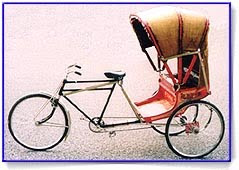
The three wheeled cycle rickshaw is a unique and somewhat ancient form of transport, deriving its front from that of a bicycle and back from a Tonga or Bullock cart :)


I have a personal liking for these as against the modern day vehicles.
At the heart of the concept lies the human engine which is made up of 'calf 'and 'thigh' muscles, the fuel used is 'carbohydrates' (while some variants also operate on 'fat') which comes built-in with the engine, the by product that gets emitted is 'sweat'…

Apart from efficiency, some other reasons why I personally prefer/enjoy cycle rickshaw rides more are:
  1. Speed… (The slow speed actually concurs well with my relaxed and laid back attitude)

  2. Convertible… so what if I can't afford the convertible model of BMW (The simple design of these cycle rickshaws allows them a convertible roof) What this means is that you can enjoy bits of wind/breeze, sun or rain while travelling, depending on what's in menu for the day.

  3. Peace of mind… You go at your own pace enjoying the beauty around (both natural and mad made), traffic is least of your concerns (sometimes a blessing) and there is hardly a sense of competition with other vehicles around. This not only reduces chances of accidents (leaving happy accidents) but also makes the overall experience pleasant (in contrast to commuting in metros under loud horns, dark clouds of smoke and mental abuse :))
It was the year 2001, I was finally out in the civilian world..after spending 6 full years in a boarding school. I got started again on what I did best, negotiating and bargaining, applying price value comparisons on almost anything, surveying people (most often the common man … milk man, rickshaw wallas, drivers, shopkeepers and on and on and on), understanding individual perspectives, understanding how people made a living and decoding business models.

The city was Allahabad, the city of god, the city of rivers and sangam, the city of kumbh, the city of Nehru and Gandhi, the city of temples, good chat stalls and awesome food joints. Attributed to the small size of the city, you could reach almost anywhere by travelling a few miles (or few minutes). Above all, the city life was as slow as I could have possibly desired for myself.

Coming back to the cycle rickshaws…
During my initial days at college, I'd make at least 3 round trips a week to various places whether for buying books, groceries, mango shakes in katra, eating out (escaping mess food) or watching movies. Since all these trips were made on cycle rickshaws, what this indeed resulted in was my survey of about 2 dozen cycle rickshaw wallas by the end of my first month and by now I had begun to understand their lifestyle and day to day issues in and out...

A typical cycle rickshaw back then costed around Rs: 4000/- (or $80)
Most of the cycle rickshaw men hired cycle rickshaws from a lender.
The rent for a cycle rickshaw would typically be:
Rs. 12/- per day (6 AM to 8 PM) and Rs. 8/- per night (8 PM to 6 AM)
This meant a rental income of Rs. 20/- (0.5% of the price of vehicle) per day for the lender, potentially translating into Rs: 7300/- for 365 days of the year.

However, let us account for approximately 65 idle days in a year (or 5 idle days every month) of no rickshaw lending activity (attributing to holidays, repairs, demand-supply gap, riots/strikes etc)
This still means 300 days of leasing (a healthy 82% utilization), translating into a rental revenue of Rs. 6000/- (or $120)(or 150% of the price of vehicle)
[Note: This is without accounting for interest from recurring deposit of Rs: 20/- for 300 times in a year]

The lifetime of a cycle rickshaw can be anything between 10 to 15 years (Frankly speaking, it may be used for as long as desired by repairing/replacing wheels, seat cushions or any other accessories and parts on a need basis)

Let us account another Rs. 2000/- or 33% of revenues as expenses towards staff cost, collection charges, provision for non performing assets and depreciation (non interest cost as we have no leverage).
This still leaves pre-tax profits of Rs. 4000/- (an ROI of 100% a year)

Tax liability would be unlikely due to limited quantum of profits that may not cross the tax brackets.
Having said that, I saw potential to increase average revenue per rickshaw by sticking some posters on cycle rickshaws for advertisements by local brands.
In fact, if advertisers would be willing to pay as much as Rs: 20/- per day per rickshaw for displaying their ad banner. I could in turn forego the daily rent collected from these rickshaw drivers hence running a "social" business, which was not only profitable but produced a 100% ROE :)

After I returned to college from my 2nd year vacations with Rs. 40,000/- that mom had given me for starting my equity portfolio, I kept wondering if I should instead start my cycle rickshaw lending business with 10 rickshaws bought using this money. In less than a year, I could have doubled these to 20 with a 100% ROE and 100% of profits reinvested. In the years to follow, I could have had 40, 80, 160 and soon over 300 of my rickshaws in the city.
In fact, if I decided to take leverage(bank financing) with a debt to equity ratio of 1:1, I'd be able to speed up and grow at about 200% a year.
While I day dreamt of my business plan to riches, the unwanted dreams of my engineering subjects such as physics, dynamic systems, operation research filled my nights with horror.

What I did not think of was the market opportunity and market potential.
At 200% growth rate, in less that 10 years, the city would have had more cycle rickshaws that the population :)


In fact, the whole market size for cycle rickshaws was about 300 :) and this market was already fully captured. Though it is easy to find opportune people to lend rickshaws to, but it would have only led to too many rickshaws on road, drop in cycle rickshaw men earnings due to excessive competition emerging from increased supply and lower utilization for lenders including me.

Besides, there were other challenges like barrier to entry, micro management (the lender would have to make daily collections from every person he lent to) and inventory (parking for rickshaws on days of low business) I soon realized that this was not my path to millions ("$$$") and I would have to look for an alternate business plan.

However, the real reason for not starting was lack of gut, a missing business partner and off course, engineering to cope with.

This analysis eventually helped me take back a very important lesson. While it may be good to talk of percentages for growth rate and compounding for evaluating investment returns at a micro level, it is equally important to understand the macro picture (market opportunity / market potential) in addition to having a model for scalability.

I found the same lesson explained wonderfully well by Warren Buffet in his letter to shareholders of Berkshire Hathway for the year 1989:
We face another obstacle: In a finite world, high growth rates must self-destruct. If the base from which the growth is taking place is tiny, this law may not operate for a time. But when the base balloons, the party ends: A high growth rate eventually forges its own anchor.

Carl Sagan has entertainingly described this phenomenon, musing about the destiny of bacteria that reproduce by dividing into two every 15 minutes. Says Sagan: "That means four doublings an hour, and 96 doublings a day. Although a bacterium weighs only about a trillionth of a gram, its descendants, after a day of wild asexual abandon, will collectively weigh as much as a mountain...in two days, more than the sun - and before very long, everything in the universe will be made of bacteria." Not to worry, says Sagan: Some obstacle always impedes this kind of exponential growth. "The bugs run out of food, or they poison each other, or they are shy about reproducing in public."


April 1, 2010

The Bigger Fool

Since today is April 1'st ... the Fool's day… I thought of writing and assembling something on the same topic :)


Once upon a time, in a village, a man appeared and announced to the villagers that he would buy monkeys for Rs. 10 each.

The villagers seeing that there were many monkeys around, went out to the forest, and started catching them.

The man bought thousands at Rs. 10 and as supply started to diminish, the villagers stopped their effort. He further announced that he would now buy at Rs. 20. This renewed the efforts of the villagers and they started catching monkeys again.

Soon the supply diminished even further and people started going back to their farms. The offer increased to Rs. 25 each and the supply of monkeys became so little that it was an effort to even see a monkey, let alone catch it

The man now announced that he would buy monkeys at Rs. 50 However, since he had to go to the city on some business, his assistant would now buy on behalf of him.

In the absence of the man, the assistant told the villagers "Look at all these monkeys in the big cage that the man has collected. I will sell them to you at Rs. 35 and when the man returns from the city, you can sell them to him for Rs. 50 each."

The villagers rounded up with all their savings and bought all the monkeys. Then they never saw the man nor his assistant, only monkeys everywhere...


This is what "The Greater Fool Theory" is about :)


From Wikipedia:

The greater fool theory (sometimes the bigger fool theory, also called survivor investing) is the belief held by one who makes a questionable investment, with the assumption that they will be able to sell it later to "a bigger fool"; in other words, buying something not because you believe that it is worth the price, but rather because you believe that you will be able to sell it to someone else for an even better price.

Some consider it a valid method of making money in the stock market, particularly momentum investors; however, fundamental investors believe that market participants eventually realize that the price level is too outrageous (too high or too low) and the speculative bubble pops. The greater fool theory relies on market optimism and market momentum concerning a particular stock, an industry, or the market as a whole.

"Sounds like playing 'passing the parcel' ... but with a
Time Bomb
"


It is similar in concept to the "Keynesian beauty contest" principle of stock investing.
http://en.wikipedia.org/wiki/Keynesian_beauty_contest


The question is whether you buy stocks that you find most attractive

or

You buy stocks that others would find most attractive (regardless of what you think about those)


However, in a world of too many fools, this does not end here, this can be carried one step further to take into account the fact that other investors would each have their own opinion of what other investors think. Thus the strategy can be extended to the next order, and the next, and so on, at each level attempting to predict the eventual outcome of the process based on the reasoning of other rational investors :)


It is true that "Markets are like Voting machines… "
However, your Investment decisions or opinion need not be the "Average" opinion on the street (that too , of a street that itself looks at others opinion to derive its own)
Instead, use your right/freedom to expression, use democracy to your advantage and for the general good


(Why not Vote for the person you like instead of trying to predict who would have maximum votes)

Now that's a difference between "speculating" and "investing" …
For Investing you would look at inherent qualities of the politician (or that of a company) rather than looking at popularity or mob predictions!

(It all goes back to my yesterday's blog about going against(or at least independent of) the market and Ben's theory on Mr. Market)

I see this as one of the growing problems with the market today...
(To be honest, this is but a reflection of our society today... )

People today are more concerned about what others think and what others are doing ?
"Tell me, what do others think about me ?"
"Will everybody like my new dress ?"
"blah blah blah….because everybody else is doing it… ! "


I see this ("watch out what others are doing") phenomenon is more popular in bull markets (good times) when everyone seems to be doing well...

It is only in bear markets or bad times (failures in life) that people make an attempt to look inward...

I guess that's why we need cyclical markets :)
[A "bear" or "beer" every once in a while is what we all need]

To add further, these days many sites display the average target price of N investors, the average expectation of results of N investors, the average recommendation for a stock based on buy/sell/hold ratings by several analysts/investors…

If you have thought as much and in case you believe this is the right approach, then you obviously understand that Market prices are determined by millions of people and hence they ought to be fair… aha, "The Fair Market theory"...

Unless you have confidence in your intellect and resulting decisions and the strength and patience to stand by it… you are unlikely to outperform the markets…

"More often than not, try to leverage your innate self, your IQ, your creativity/art, your innovativeness, your hobbies, your comforts, your choices, your beliefs, your passion and yourself… you you you" (without being an egoist :))

"Don't undermine your worth by comparing yourself with others. It is because we are different that each of us is special"


Wow, now that reminded me of "The Fountain Head" by Ayn Rand

March 31, 2010

"Investing" - a perspective

So what is Investing ?

For the sake of providing a definition, here is the simplest one that I have come across so far:

"Investing is putting out money to be sure of getting back more money later and at an appropriate rate"

Yes Yes ... I hear you… I agree it's a very simple and generic definition.... but that's the way it is…

Investing, as I understand is a lot about "Perspective"
(what feels like "gold" in the hands of one, could feel like a "mine" to someone else)
Trying to generalize Investing by your taste/understanding and mixing perspectives may not always result in a "goldmine", so to say...

On a more serious note this time….

How do you make Investment decisions ?
How do you decide whether a deal available in the market is good ?

Answer: By comparing the 'Price' and the 'Value'

Price: How much is it selling for ? (Market)
Value: How much do you think it is worth ? (Intrinsic)

That's All!
While the Price is offered by the Markets, you need to find the Value on your own.
The trick however is that there is no Universal Value and there is no correct or incorrect value…
This means neither will searching Google help you "find" the value, nor will using Bing help you "decide" the value…

Now the question is, how do I then arrive at the Value ?

What differentiates Investors from each other [other than 'Perspective' and 'Composure (including emotional)] is how they 'Evaluate'…
This is the single reason 'why Investors are not commoditized' and 'why Investing is not automated' …. :)

Now for Valuing, you may use any data/approach you like from studying business models, to strategy, balance sheet, cash flow, free cash flow, dividends or dividend yields, brand value, patents, culture, promoters, employees, RoE, moat, book value, sales and profitability, growth in business, profitability or holdings, study the sector or economy, correlate it with macro economic factors like GDP, liquidity, unemployment rates, bank interest rates, bond yields…….and on and on and on from business to business.

You have your freedom to approach it the way you like…but more importantly, do it yourself and know what you are doing...

(Perhaps, I will talk more about my way of valuing companies in a separate blog later)

One interesting dimension to valuation is:
Value of something today versus Value of something in the future (as expected/projected/estimated) …. i.e.: 5 or 10 years thereafter
[This dimension builds the foundation for long term investing! ]

However, you do not arrive at the value by asking friends or reading recommendations or listening to analysts or looking at the stock price or the historic stock price range…..

Three common mistakes Investors make with Investing/Valuing

1. Depending on other people's recommendation or valuation (most often: analysts, articles and friends)
Two reasons why you must do your homework yourself:


  1. There is neither going to be an "understanding" of it nor any "learning" from it unless you do your homework yourself
    (And more that anything else, Investing is about experimenting, learning and growing as an Investor)
    "Give a man a fish, and he’ll eat for a day. Teach a man to fish and he’ll eat for the rest of his life"
  2. Who do you blame when you lose money ?

2. Using the Price Tag to find the value of a productThis is as funny and as stupid as it can get! Yet over 99% investors are unable to escape from this temptation!
Look at the business first, see how much it is worth, then look at the market price and see if it looks attractive.
If you look at the price first, you are bound to get influenced by it ….and your Value of the business may tend to confirm to or towards the Price…
Again, the relatively smarter ones should know that seeing the range of the Tag price for last 52 weeks is also not going to tell you the Value….
Remember that the best opportunities for investment are the ones where Price and Value are farthest apart (leave aside growth for now)

I for one apply the same approach to bargaining and find it awfully interesting to observe people when they negotiate… :)
(I will in fact write a separate post on my approach to "bargaining" some time … :))

3. Bottom-Up instead of Top-Down
I believe the way to study and value a business is top-down.
You look at the business in totality, look at its existing and potential market, looks at revenues, profits, cash flow, assets, debt etc, then come up with a value that you think it is worth(or what would you be willing to pay to buy the whole business) and compare it with its current market cap.
You can now divide your value of business by equity of the business to find how much you would be willing to pay for a % ownership in the company by buying shares.

I have seen a lot of Investors, specially retail investors go lost in per share data(Earnings per share, Dividend per share, blah blah blah)….
Many have argued with me as to what is wrong with their approach.

There are two issues that I see with this:

  1. In most cases, I have seen that people's bottom-up approach does not scale all the way to the top. I can bet that more than 90% retail investors do not know either or all of Market Cap, Annual Sales and Earnings of the businesses that they have invested in.
    On the least, have you ever done the exercise of multiplying your per share figures with total equity of the company to see how big your company is…
    Many may still not get the point. While some may actually laugh wondering "Do you really want to buy the whole company and Do you have so much money!"
  2. How do you expect to evaluate market potential of a company ?
    Funny, as I haven’t heard anyone start from thinking that XYZ company has the potential to make revenues of ABC per share
    "A man has $1 million in wealth. He has decided to distribute it equally among all his employees. Being one of his employees, you are certainly excited, but can you tell me what would be your share of his wealth without knowing how many employees he has ?" For employees such as these, I wish that the man has at least a million employees :)
Traders and Brokers excused, but if you intended to be an Investor, remember that 'Stocks are but just a medium to Invest in a Business…'
Investing is not about buying some stocks and refreshing the stock price every 5 minutes to track the health and performance of your business :)

If you cannot tell the value of something (how much should it be worth) and yet decide to own it, how would you ever know if you paid the right price, and how would you ever know it is the time to sell...
"It is like getting into a debate or an argument without having an opinion"
Can there be Investors without a Perspective (or an Investment philosophy) and without a Value for their businesses in mind?

Leaving product, service or need based Markets aside and talking about stock markets…..

If you come to think if it, the very foundation of Markets is based on the differences in Opinions and Perspectives
Every time someone is buying a stock, someone else is selling it
(Under all normal circumstances, Every single trade/transaction reflects contradiction in what 2 people/parties believe)

Alternatively, If everyone thought alike, there would be no transactions :) [Under all normal circumstances]

A lot of questions start getting answered as you take eyes and time off the stock prices and start wondering why Markets were created...
(I will leave the exercise to you as this questions is best unanswered)

Coming back to Valuing, Investing and Markets:
For most part, you make money by going against the market.
You buy or sell when you are convinced that the price offered by the markets does not reflect the true value or potential ...

On a closing note
Use markets as a tool for Investing, exploit and take advantage of them when they seem irrational… But more friendly you get with markets and more you start gossiping, singing and dancing together, less are the chances that you would find more compelling opportunities…under the influence of your friend...

I recommend reading Mr. Ben Grahams theory on Mr. Market !

March 29, 2010

How it all Started

It was the summer of 2003 and I was still in my last teen…

As an intern at Wipro, there were exactly two expectations from me:
  1. Thou shall reach office before 9 AM and shall not leave office before 6:30 PM
  2. Thou shall not Sleep in office …..

Spend some time studying about various web technologies online ignoring the fact that there was no computer allocated to me, there were 3 of us sharing the same computer….

Do whatever you feel like except sleeping, except browsing and except talking….. So this left very few options for me…. day dreaming, Introspection, coffee and still Sleeping (sometimes covering face with books or notes…. and sometimes hiding under the desk :)

One thing that I really liked about the company (or at least the promoter) was that Mr Premji, Chairman (who was then also the richest man in India) used to stand in the cafeteria queue(once right behind me) himself waiting for his turn to pay Rs: 18/- for the South Indian buffet lunch (Unlimited :)) [It felt like there was no need to be rich]

One of my companion who was a senior intern (a post graduate appointed as a 6 month intern for the second time) had a relatively busy schedule….his job involved noting the latest stock price of Wipro Infotech from NSE and BSE and updating it on the official Wipro website every couple of hours….
This dude was priviledged and had a sense of pride .... Specially because he had access to the lab, which housed the client machine that was used to connect to a server which intern remotely connected to the main server that hosted the Wipro website…. huh

For the first few days, I just wondered why couldn't they write a script (once and for all….) to fetch live stock prices of Wipro from NSE and BSE websites and automatically update them on Wipro website (not every 2 hours, but perhaps every few seconds)
Instead of hiring a full time intern to do this manually. I used to wonder what Value he brought to the company, leave aside me whose job was but just to observe and wonder, after all….
It was however good in the sense that it created a job for one more person, made one more bachelor eligible for marriage….and perhaps helped one more man(family) make a living…. :)

Blessing in disguise: my companion decided to delegate the work of noting the stock prices from NSE and BSE websites to me….. Off course, this meant giving the machine and web access to an untrusted party…..i.e.: me :)

I soon began to check stock prices of various other companies (whichever came to my mind), like Infosys and Satyam as they were Wipro's natural competitors……Bata, as I was wearing Bata shoes, Britannia, as dad worked at Britannia, Union bank, as mom worked there….Reliance, because everyone knew this one…..ICICI, because I had seen it in the ads ... and so on…..

In no time, I was tracking over 40 companies and checking their prices at least 40 times a day….. Yes, that's 1600 refreshes!
It was time for lots of stupid questions and stupid guesses….like "higher the stock price, more prosperous the company :)",
"Cheaper the stock price, smaller the company and hence more potential for growth :)"
(I still remember a stock (sri cement ltd, not sure if I am recalling the name correctly ) which was trading at 20 paisa, huh….that's less than half a cent…one that I had decided to make my fortune with :))

I explored and found out the difference between NSE and BSE, nifty and sensex… and imagined answers to the rest of the silly questions myself...
I soon started tracking various company announcements, results, charts, shareholding pattern and what not (most of which, *correction* actually, pretty much all of which obviously went over my head)….But I enjoyed the pride in opening this stuff (and faking understanding of it) in front on several other engineers who were equally illiterate/dumb in finance, however not as smart :)

I quickly followed the activity by studying stocks in my dad's portfolio, most of which were held for 15 years or more….some like HDFC and HDFC Bank had grown 10, 20 or 50 times and made him a fortune...... while several others had ceased to exist… (a surprising observation was that some of the small commodity stocks had lingered around pretty much the same price levels through these 2 decades)

With my rapidly growing interest….In no time, there was a third expectation set for me as a summer intern:

3. Thou shall not access the NSE or BSE website from office :)

So I obviously got back to my desk, and this time I had more pronounced day dreams…dreams of making lots of money and being rich…
As I spent more time away from the markets and refreshing stock prices, pondering about what this was all about...I began to realize that there was something missing, something incomplete in the story that I had understood in the last few days……

One thing was sure, that all of Investing was certainly not just about the stock prices and stock tickers….. There had to be something more to it… something more fundamental or at least something differentiating…. Something other than just buying / selling shares and the moving prices…. The thought kept bothering me for a long time…on and off…..until I met Uncle Harish (more later) ….


Meanwhile, in weeks and months that followed, I enjoyed refreshing(F5!) the stock prices and tracking various of them….

Before my internship at Wipro was over, I already had a Virtual Portfolio at MoneyControl, had setup my savings, demat and trading account with HDFC Bank and had convinced mom for a partnership and for sponsoring me with the starting capital…. :)

Mom's are always like that…they can't say NO…..at least not the first time you ask for something….. My mom for a change, continued to fund me with more capital every time I asked for a little more…expressing opportunities and my expansion plans.... After all, she had been a banker for 25 years !

During the course of the semester that was to follow.... while most of my friends spent time taking extra classes, playing and going out..... I often found myself in banks, getting IPO applications, reading red herring, writing cheques and appling for the IPO's that season...

Coming back to college, I realized that coping up with engineering was only going to be all the more difficult now…..